Pending delete is the last stage of an expired domain name before the registry releases it. It lasts 5 days. Nobody can renew or restore the name during those days — not even the owner who let it go — and on the 6th day it is released and anyone can register it.
Where pending delete fits
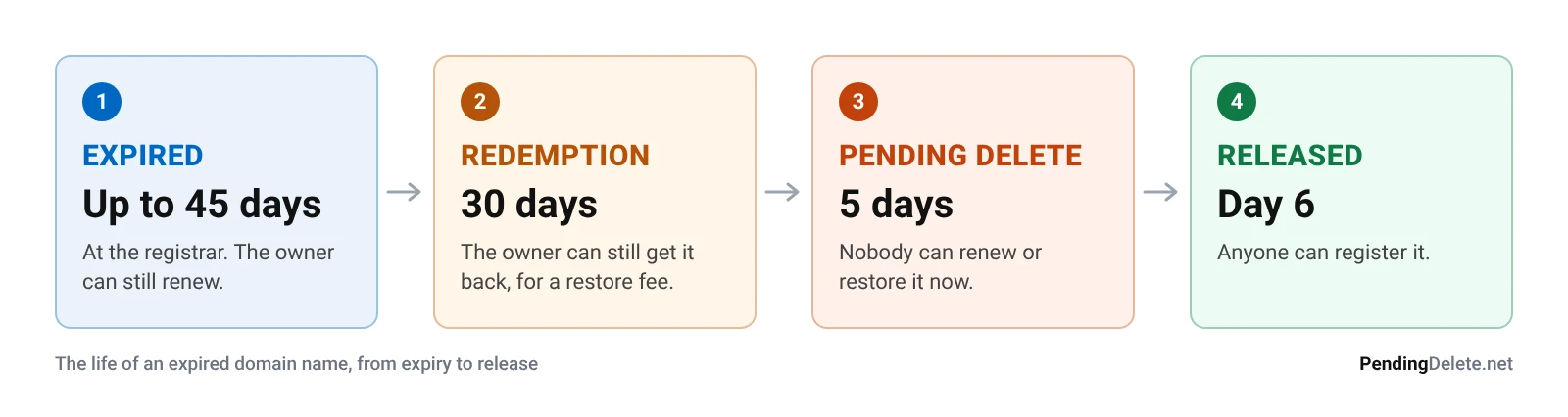
- Expired. The owner didn't renew. The registrar usually holds the name for a few weeks, and the owner can still renew it.
- Redemption. The registrar deletes the name. For 30 days the owner can still get it back, but only by paying a restore fee.
- Pending delete. 5 days. Nothing can stop the release now.
- Released. On the 6th day the registry drops the name and it is open to anyone.
What happens at each stage
Expired
When a .com or .net name passes its expiry date without a renewal, the registry renews it automatically for a year and gives the registrar 45 days to keep it, or to delete it and get the fee back. How much of that time the owner gets is up to the registrar. Until the registrar deletes the name, the owner can usually renew it at the normal price.
ICANN's rules make the registrar cut the name off for at least the last eight days it can still be renewed: its website and email stop working, often replaced by a parking page with renewal instructions.
Many registrars auction expired names that look valuable during this stage. A name that sells there goes to the buyer and never reaches pending delete, so the names that do reach it are ones nobody renewed and nobody bought.
Redemption
The registrar deletes the name, and the registry holds it for 30 days. ICANN requires this of .com, .net, .org and almost every other generic extension. Only the last owner can get it back, through the registrar that deleted it, and it costs a restore fee on top of the renewal. Each registrar sets its own fee.
During these 30 days the name can't be transferred, and the registry takes it out of the DNS, so it stops working everywhere. It also drops out of the registry's zone file, the daily list of names with working nameservers. That is the first public sign a name is on its way out, and it is how our lists find names to check with the registry.
Pending delete
After 30 days without a restore, the registry moves the name into pending delete. Some registries do it in one batch a day, others name by name; our Flip times page shows which, and when.
From then on nothing changes the outcome. The owner can't restore it, the registrar can't renew it, nobody can transfer it and nobody can register it. It is the only stage with a fixed end: once a name is in pending delete, the day it drops is certain. Our Pending Delete page lists them by drop time.
Released
On the 6th day the registry deletes the name for good, and it can be registered again — first come, first served, at the normal price, through any registrar.
Drop-catching services keep many connections open to the registry and send registration requests the instant a name is released, which is why a good name can be gone within seconds. A name nobody raced for simply stays available, and anyone can register it later. We check each released name with the registry and show whether it is still available or was caught.
How to tell which stage a name is in
Look the name up and read its status, not its dates. Search it here and its page shows the status the registry gave us and, for a name in redemption or pending delete, the day it is due to drop. ICANN's Lookup tool shows the registry's own record.
What the status says:
autoRenewPeriod— expired, still with the registrar (not every lookup shows it).redemptionPeriod— redemption, even withpendingDeletebeside it.pendingRestore— redemption, and the registrar has asked to restore it.pendingDeleteon its own — pending delete, the last 5 days.- No record — nobody holds it: released and not taken yet, or never registered.
The expiry date catches people out. Because the registry renews a .com automatically when it expires, a lookup can show next year's date on a name that is on its way to deletion. The status is what counts.
Can you register a name that's in pending delete?
Not yet. The registry won't take a registration until the name is released, and nobody can hold it for you: a backorder is a promise to try at the drop, not a reservation at the registry.
What you can do:
- Backorder it with a drop-catching service before the drop. It tries the moment the name is released; you usually pay only if it catches the name, and if several people backordered it, it often goes to an auction between them.
- Try at the drop yourself. If no service catches it, you can register it at any registrar. Dropping today lists the names due today, and Drop times shows when each registry releases them.
When does it drop?
A name is released on the 6th day after it goes into pending delete: the day it goes in, 5 full days, then the release. A name that goes in on a Thursday is released the next Wednesday. For .com and .net that is 36 days from the day the registrar deletes it.
Each registry releases its names at its own time of day; for .com and .net, Verisign deletes each day's names in one batch. Our Drop times page shows when each registry has been releasing, measured every day.
Not every extension works this way
The 30-day redemption and 5-day pending delete are the rule for .com, .net, .org and most other generic extensions. Country-code extensions such as .uk and .de set their own rules, and some skip redemption or pending delete entirely.
Sources
- ICANN, EPP status codes: what
autoRenewPeriod,redemptionPeriodandpendingDeletemean. - ICANN, Expired Registration Recovery Policy: the 30-day redemption period and the cut-off before deletion.
- ICANN, 5 things every registrant should know about the ERRP: the renewal grace period of up to 45 days.